Introduction
Building a squad is one of the most complex tasks Sporting Directors face. It requires strategic thinking and a great deal of agility.
Does the team have enough depth to cover potential injuries?
Is the squad future-proof?
Are we enabling youth development?
While some of those questions will be answered proactively, a lot of it will also be dictated by player movement, budgets and national rules in place.
In this article, we will take a closer look at how some of the most high-profile teams allocate playing time, and how that can lead to success on the pitch.
Large squads vs small squads
We collected data of the 24/25 season in Serie A, Premier League and Bundesliga and looked at how teams allocated their league minutes across the season.
In this study, we excluded players playing under 300 minutes, to avoid counting sporadic appearances or league debuts given at the end of a match.
To begin, we studied how much teams rely on their first 11.

The first noticeable trend is that Newcastle and Napoli relied heavily on their first 11. They allocated around 80% of total available playing time to their 11 most used players, however, they were also the only two teams in the group who were not involved in European competitions in 2024/25.
This feeds the theory that European load is a major driver of rotation patterns and must be considered in the squad building exercise.
Chelsea and Liverpool were closely behind them, while Inter, Bayern and Juventus split their minutes more evenly across more players.

There’s a strong positive link between players used and how broadly minutes are spread (corr ≈ 0.76), but clubs convert that depth very differently.
Inter and Bayern turn squad spots into real minutes while Chelsea and Leverkusen use many players but minutes are spread less evenly.
Two different ‘large-squad’ models show up.
Broad rotation: Inter/Bayern spread minutes widely (few ≥2000’ key starters, lots of 1000/2000 minutes contributors).
Big core of regulars: Atalanta (12 players ≥2000’), Liverpool/Newcastle (11 each) many heavy-minute players but still relatively centered around a clear starting 11.
Minutes per position – The Rise of the specialist
In the second part, we study how minutes are spread across the different positions. This is a key part of squad building as this dictates the number of players required to cover different positions.
When it comes to Goalkeepers for instance, in the group of teams we studied only Arsenal, Atalanta and Borussia Dortmund used a single Goalkeeper in their league season. With most teams needing at least two keepers, clubs must insure the position with 2–3 senior options depending on risk appetite.
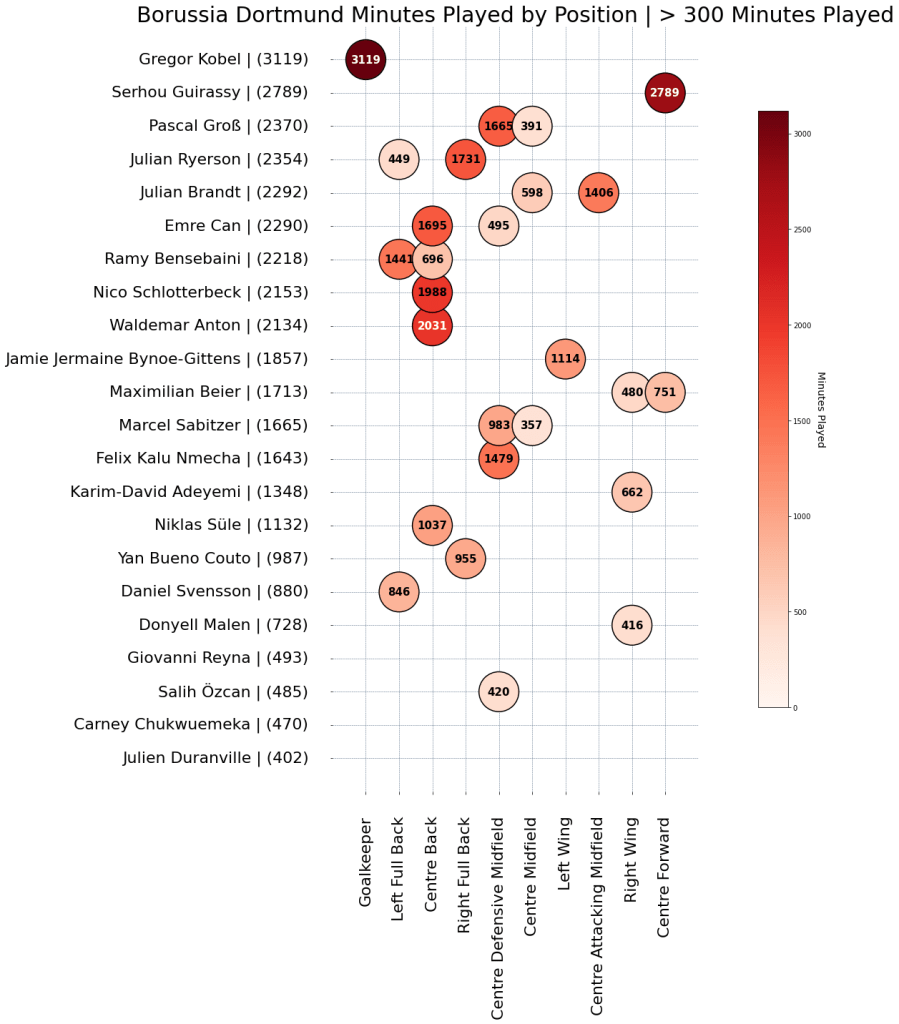
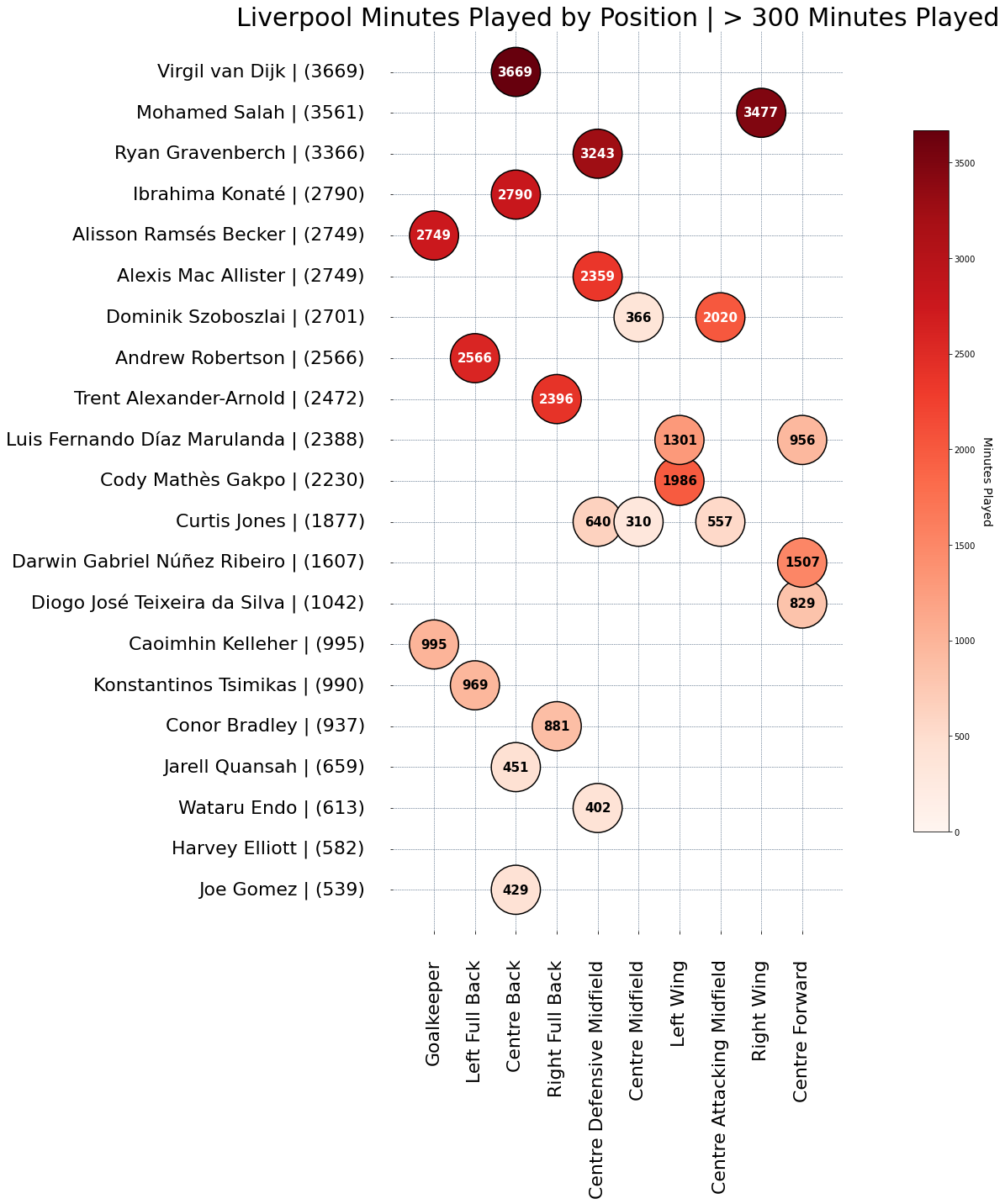
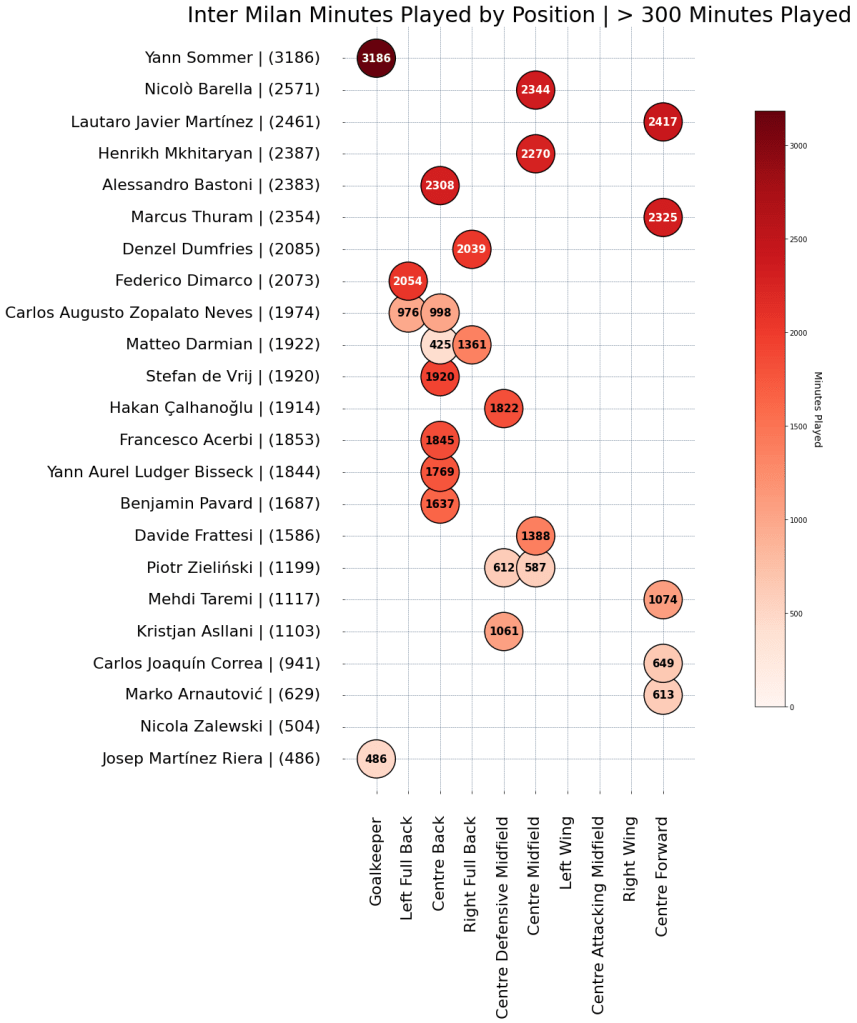
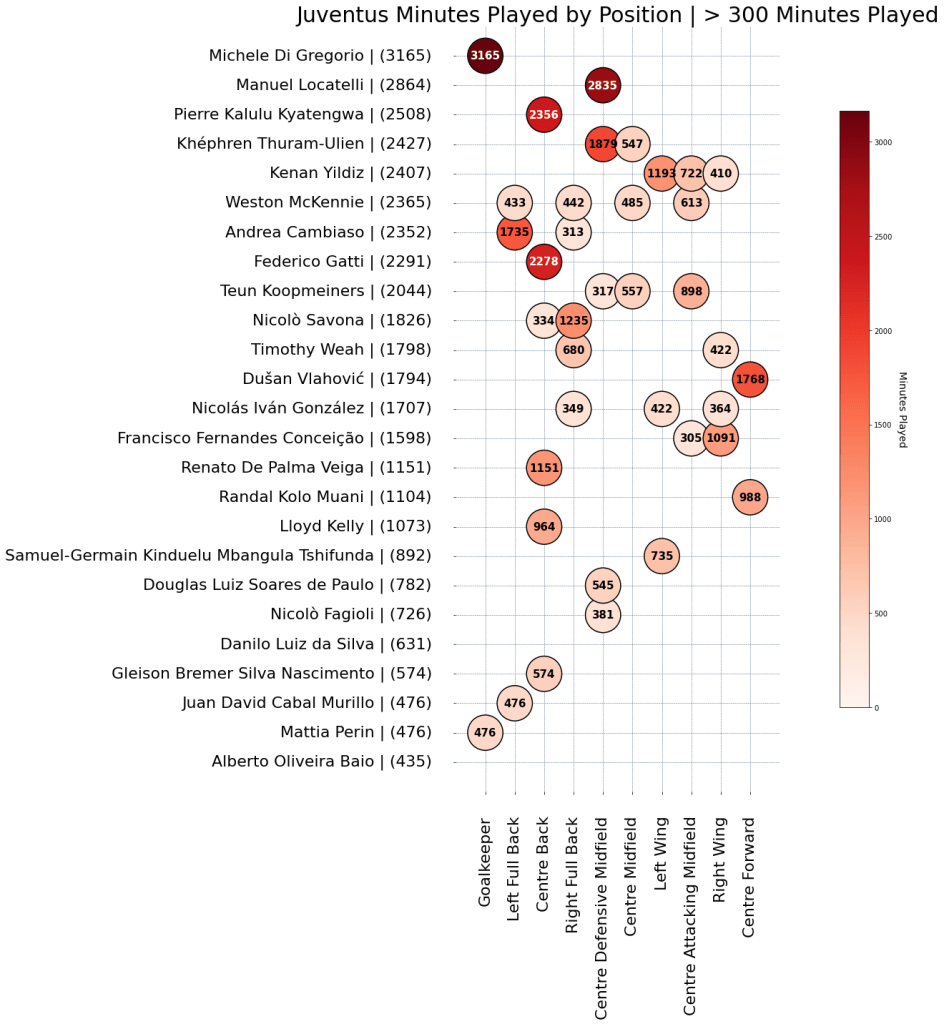
Another interesting trend is that teams seem to value specialists more than versatile players. In all the teams analysed here, we find relatively few players allocated significant amounts of playing time in more than one positions.
This was particularly true for Inter Milan or Liverpool, where almost every player is a specialist.
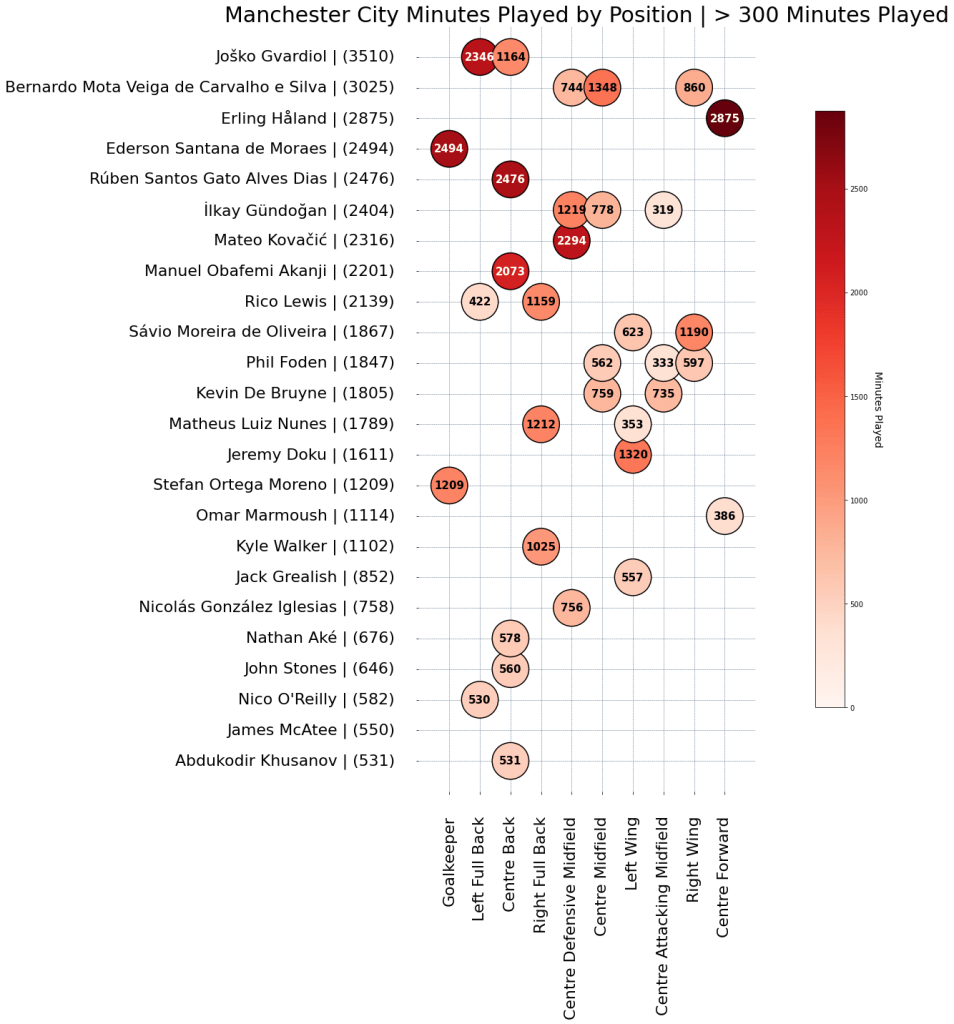
Two teams stand out in the aspect, Manchester City and Juventus, who have multiple players deployed in multiple roles. Phil Foden, Bernardo Silva, Kenan Yildiz or Weston McKennie are good examples of this.
Age analysis
Of the sample of teams analysed here, Chelsea were the team with the youngest average age (24.1), followed by Juventus (25) and Eintracht Frankfurt (25.1).
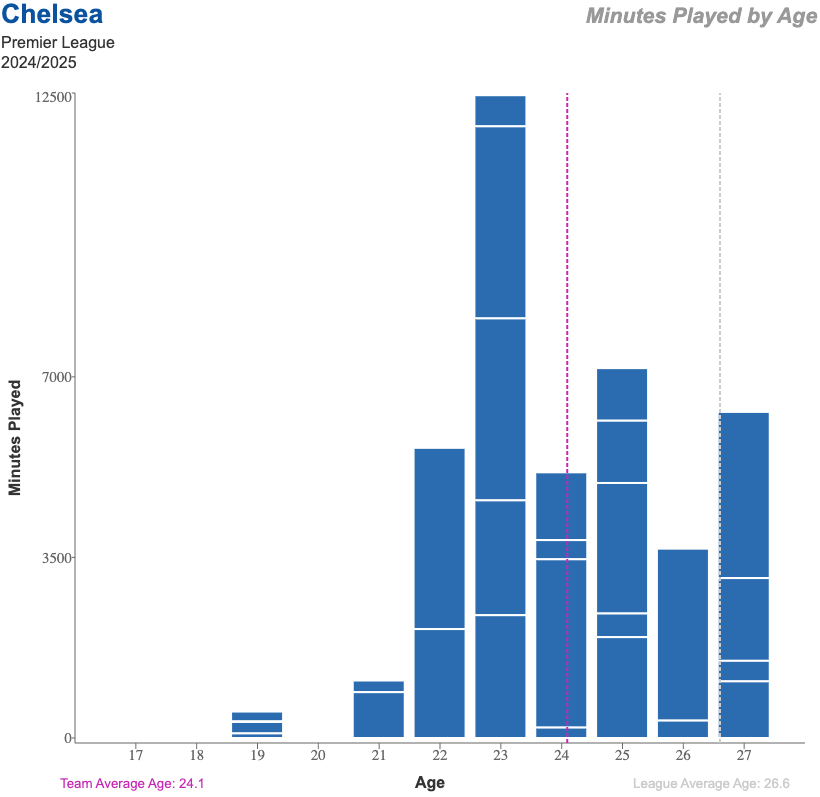
Chelsea are particularly noticeable with a very compact range of player ages and no player above 27.
For Chelsea and Juventus, this is about establishing a solid foundation for future success. For Eintracht, this reflects an established strategy of developing talent to and strengthening the team financially through player sales, while maintaining a high level of performance.
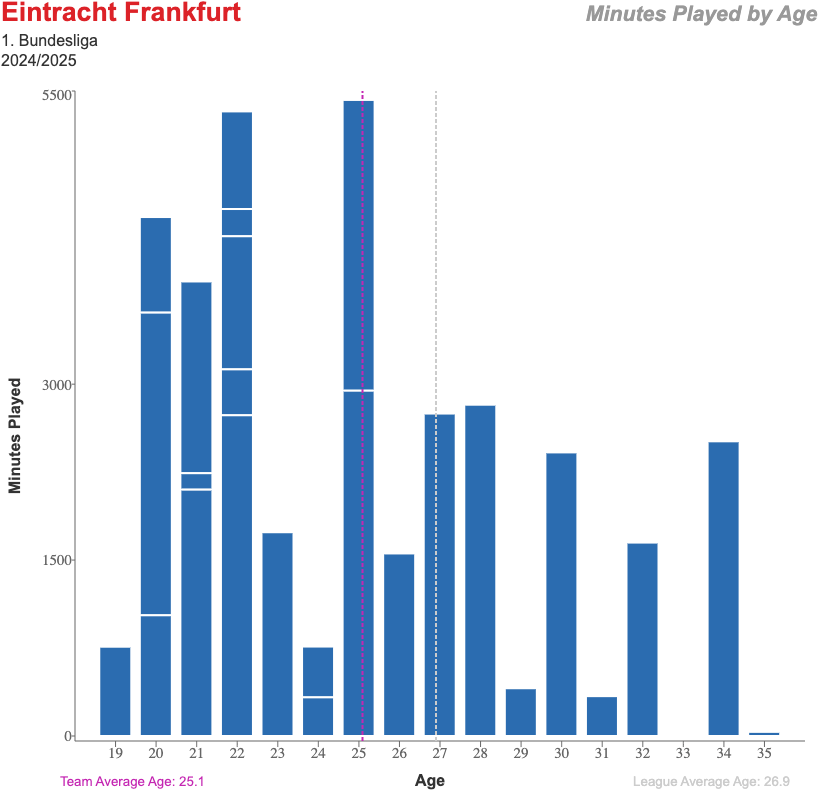
For Eintracht, the high
number of 20, 21 and
22 year-olds receiving
significant minutes shows
the high focus on youth
development.
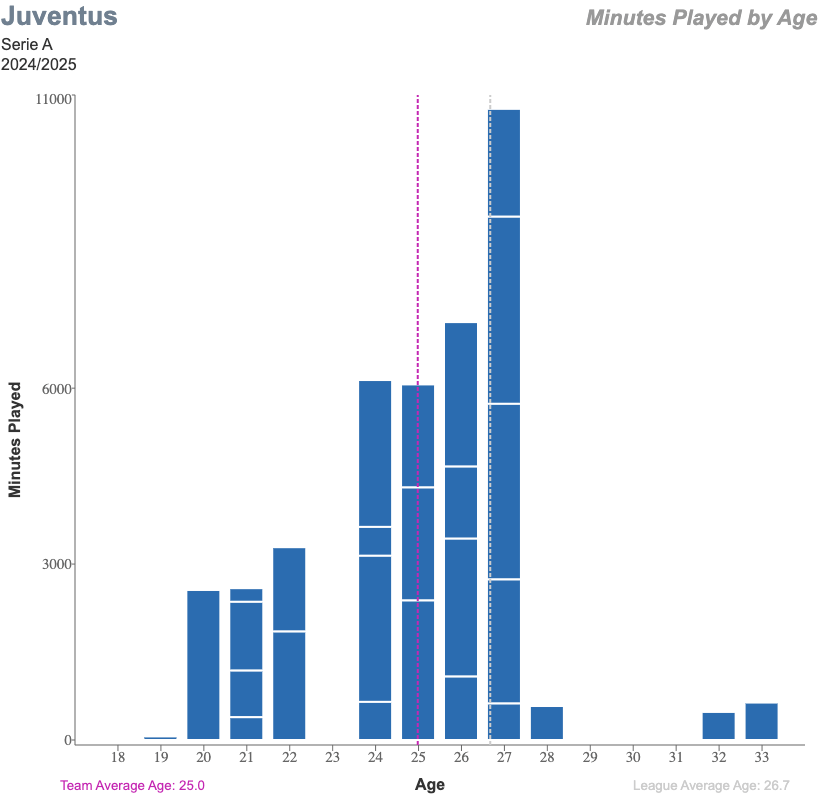
Juventus, while still
comparatively younger than
most teams, have more
players between 24 and 27,
closer to what is traditionally
considered peak ages.
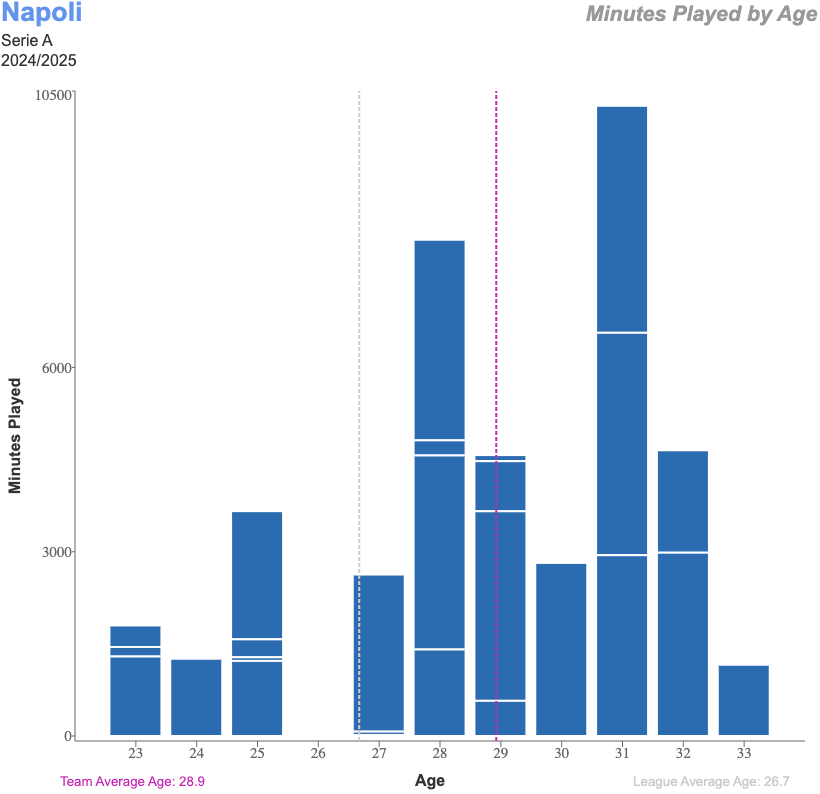
For Napoli, there is a
concentration of players
between 28 and 32, and
some succession planning
may be required.
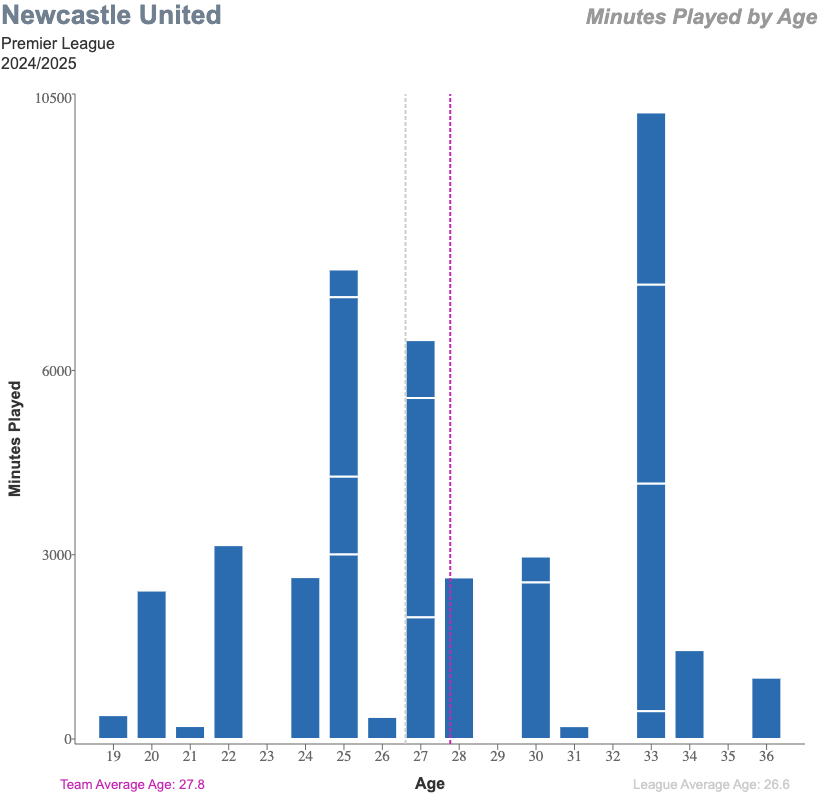
Newcastle’s case is very
different, with almost all
ages represented in the
squad but with peaks at
33, 25 and 27.
Conclusion
Across Europe’s elite, we encounter multiple squad building models that we can split in two broader approaches.
Some clubs win with broad rotation, spreading minutes across a larger pool and insulating themselves against injuries and fixture load. Others succeed with a big core of regulars, concentrating minutes but keeping standards and on-field cohesion high. What matters is not how many players you register, but how effectively you convert headcount into meaningful minutes.
Our data shows that by the time you reach 16 to 18 trusted players, you’ve covered ~95% of league minutes; beyond that, depth must be purposeful: developing young players or creating specialist replacements.
While most teams lean toward specialists, Manchester City and Juventus were notable exceptions and manage to extract value from versatile profiles.
Finally, age shapes the horizon: younger cores (Chelsea, Juventus) are building runway; older cores (Inter, Napoli/Newcastle) must actively manage succession and resale value to avoid cliff edges.
For sporting directors, the implications are clear:
- Decide early which model is worth pursuing taking into account the current resources and the fixture load.
- Target rotation effectiveness, not just squad count: if the bench never plays, it isn’t depth.
- Consider balancing specialists with a small set of elite generalists who unlock rotation without drop-off.
- Manage age like a portfolio: minutes played per age matters more than the average.
- Build for 16 to 18 you trust, know why slots 19 to 22 exist, and let your minutes distribution reflect the strategy, not circumstance.
 Antoine Maratray
Leave a comment