Physical performance data has become a crucial tool for understanding how football is played today. Clubs and national teams use advanced GPS solutions to prepare their teams in the best possible way to the demands of the game. It is not only about who runs the most or who records the fastest sprint. These numbers tell a story on how teams set up tactically, how they press, how transitions are managed, and how much intensity different positions demand. For a league like the Polish Ekstraklasa, where clubs balance domestic competition with aspirations in Europe, physical trends are a window into how the game is evolving.
For the last two years, physical parameters have been collected using broadcast tracking techniques, opening up possibilities of understanding the physical characteristics of players outside your team. In this document, we take a deeper look into the trends in Ekstraklasa and abroad.

League-wide Trends
First of all, let’s see what the average player’s physical output is in different leagues. To do that, we kept only players having played over 900 minutes in the 24/25 season. Interestingly, France Ligue 1 players cover more distance per 90 than in other leagues. When it comes to Ekstraklasa, we see that the average outfield player covers similar distances to the average Czech Liga or Austrian Bundesliga player. Compared to England, Ekstraklasa players perform about 20% fewer sprints per 90 than their Premier League counterparts. The average sprinting distance covered is close to other selected leagues.
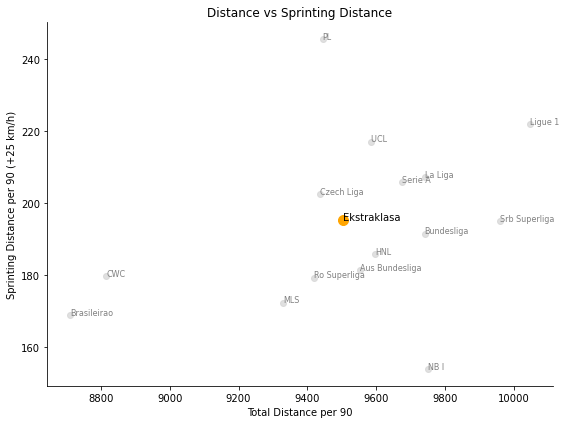
Now let’s try to focus a little more on intensity. The data collected offers speeds, distances but also counts of different run types. A “High Intensity Run” is defined as a run exceeding 20 km/h.
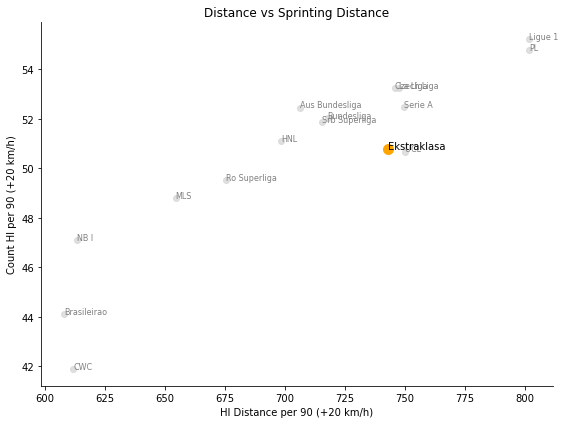
The French Ligue 1 and the English PL seem to have players able to repeat those highly intense efforts. In comparison, the average Ekstraklasa player makes fewer intensity runs and covers significantly less distance, posting numbers closer to the average UCL player.
Trends by Position
While the study of the average player may give us an idea of the trend, positional data may help understand some of the intricacies and differences in the tactical utilisation of players.
Traditionally, we expect midfielders to be the workhorses, consistently covering the most ground. Wide players, particularly wingers and wing backs, show the highest sprinting distances, reflecting their role in stretching defenses and driving transitions. Central defenders log the lowest distances but still maintain competitive sprint figures, underlining the modern expectation that defenders must also contribute athletically.
Let’s focus on Poland and surrounding countries in this example. Ekstraklasa Centre Backs and Strikers tend to cover shorter distances per 90, while other positions are closer to the average. Interestingly, players from the Serbian Superliga tend to cover greater distances.

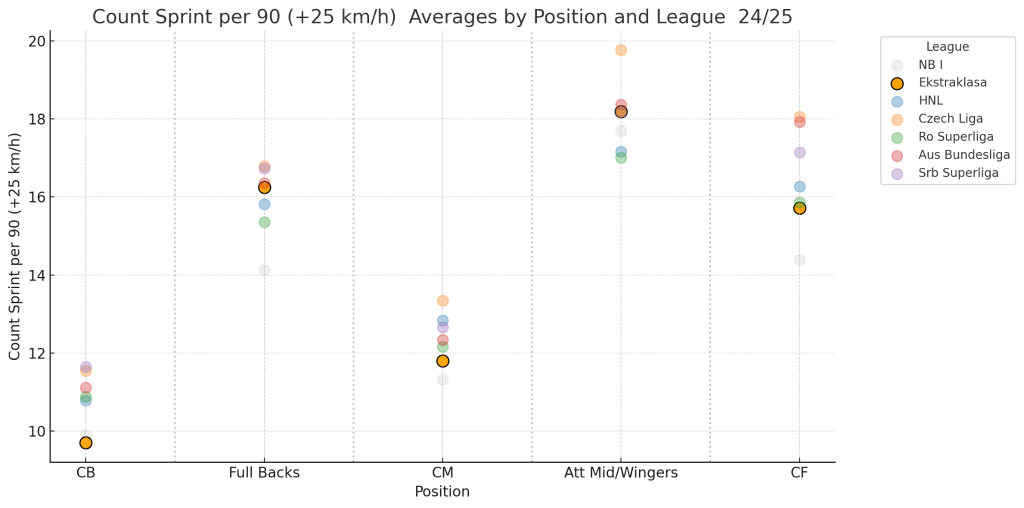
When focusing on sprints, we see that Ekstraklasa Centre Backs perform fewer sprints than their counterparts in other leagues, however Full-Backs tend to do more. Other positions tend to be closer to the average.
Implications for Recruitment
The understanding of players’ physical output can become a crucial insight when assessing the ability of player to cope with the league physical specificities. It becomes an equally useful tool to identify gaps in a squad or specific training needs.
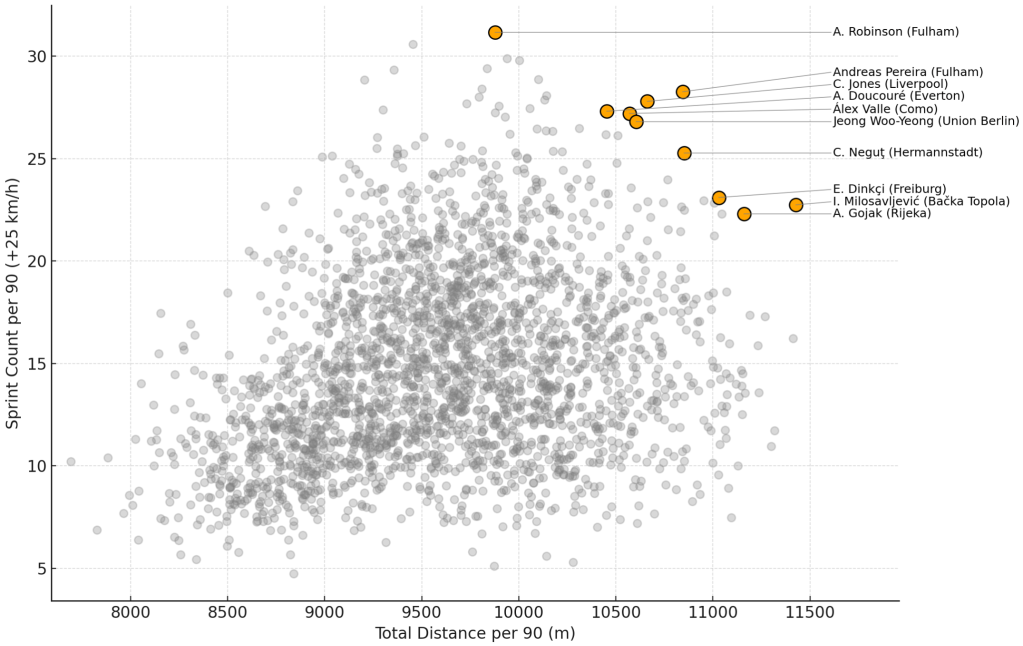
Similarly to event data, physical parameters can be used to identify outliers, as in the example below, highlighting players covering large distances and able to repeat high numbers of sprints. Fulham’s Andreas Pereira or Liverpool’s Curtis Jones are great examples of this. Antonee Robinson or Ivan Milosavljević stand out by their ability to either repeat sprints of cover large distances.
Concluding thoughts and next steps
The physical data derived from broadcast tracking has given us valuable insight into the differences between leagues. It was particularly interesting to observe that the average Ekstraklasa players cover comparable distances and perform High Intensity Runs or Sprints similarly to some of Europe’s top leagues. With the physical data becoming a prevalent tool in scouting, it is key for player valuation that players perform highly in those metrics.
Closing this physical gap is not just a matter of fitness but of competitiveness. For Hungarian clubs, matching the intensity of European opponents will be key to turning domestic dominance into continental progress.
Finally, it’s important to use physical data as an additional tool, paired with other analysis techniques, event data coupled with video remain the gold standard to understand the technical and tactical traits of a player.
 Antoine Maratray
Leave a comment