Due to travel commitments and a return to work, I was unable to produce a dedicated Matchday 3 report and instead chose to wait until the Round of 16 had been completed.
Perhaps surprisingly, especially in comparison to previous AFCON editions, the tournament has largely gone as expected in terms of results. Most favourites progressed from the group stage and carried that momentum through the Round of 16 and into the quarter-finals.
That said, several of the themes identified in earlier reports have continued to grow in relevance, most notably the question of team identity, and when to preserve it or sacrifice it in pursuit of results.
When to Keep It and When to Lose It?
One of the clearest examples of identity adjustment remains Mali. Traditionally associated with expansive, technical, and at times uncontrolled football, Mali have shifted toward a more compact, physical, structured approach, and have been rewarded for it.
Mali concluded their group-stage campaign with a draw against Comoros in which they conceded just five shots and an xG of only 0.13. That level of defensive certainty will be valuable as they move deeper into the tournament, particularly against opponents with greater attacking quality.
However, that solidity comes at a cost. One of the main concerns for Mali is the limited influence of their attacking talent, most notably Lassine Sinayoko, in zones closest to goal.
Against Comoros, the OBV origin zones revealed a worrying lack of involvement in both corner channels and the penalty area. That issue became even more pronounced against Tunisia, where just a single zone, close to the halfway line, showed any real attacking prevalence.
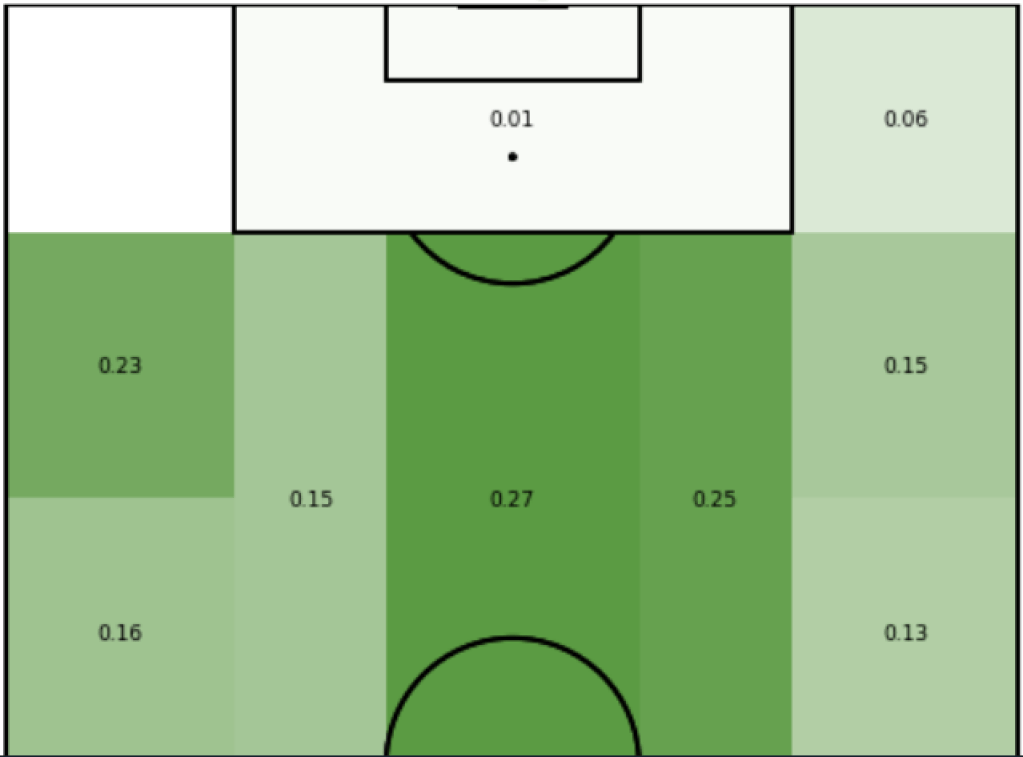
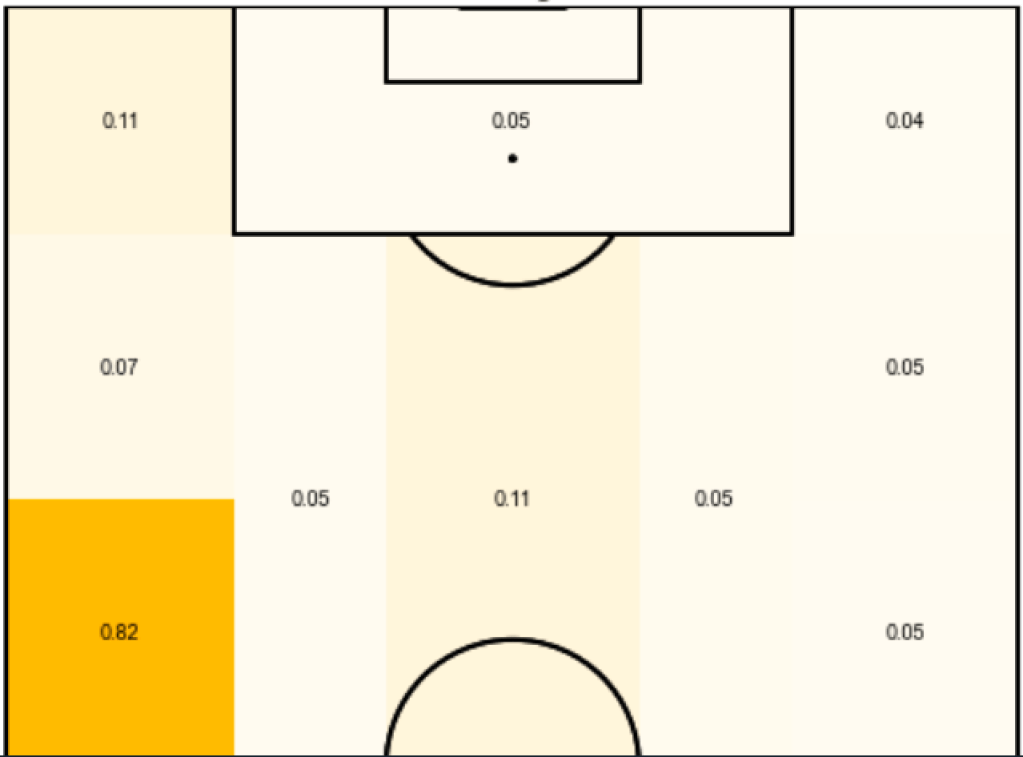
Despite this, Mali’s defensive discipline proved sufficient to eliminate Tunisia. The Tunisians were tactically interesting but lacked penetration in the final third, with Ali Abdi the only consistent outlet capable of carrying the ball into dangerous areas. Tunisia monopolised possession (72%), pressed aggressively, but entered the box 15 times from 54 attempts, yet rarely looked truly threatening.
Mali absorbed pressure confidently and saw the match through to penalties, where they appeared never in doubt.
Defensive solidity has won AFCONs in the past. However, with Senegal awaiting them next, Mali will need to complement that discipline with a minimum level of attacking threat if they are to progress further.
South Africa: An Identity Crisis
Another team to experience an unexpected identity crisis during this tournament was South Africa.
After an underwhelming group stage, where performances failed to reflect the technical quality on display two years ago, South Africa faced Cameroon in the Round of 16. Cameroon themselves had quietly rebuilt after several turbulent years.
South Africa started the match well, registering five shots within the opening 30 minutes, with Oswin Appollis once again looking sharp. Through an effective high press, sustained possession, and full-backs pushing high on both flanks, they appeared largely in control.
Yet Cameroon scored twice against the run of play in quick succession.
Despite a determined second-half response, during which South Africa created several high-quality chances, Cameroon’s defensive organisation held firm and saw them through.
This AFCON will likely feel like a missed opportunity for South Africa. Despite undeniable technical quality within the squad, they never fully settled on a clear and consistent game model, an issue that ultimately proved costly.
The Case for Extra Time
Algeria vs DR Congo and Egypt vs Benin both turned into uninspiring matches though for different reasons.
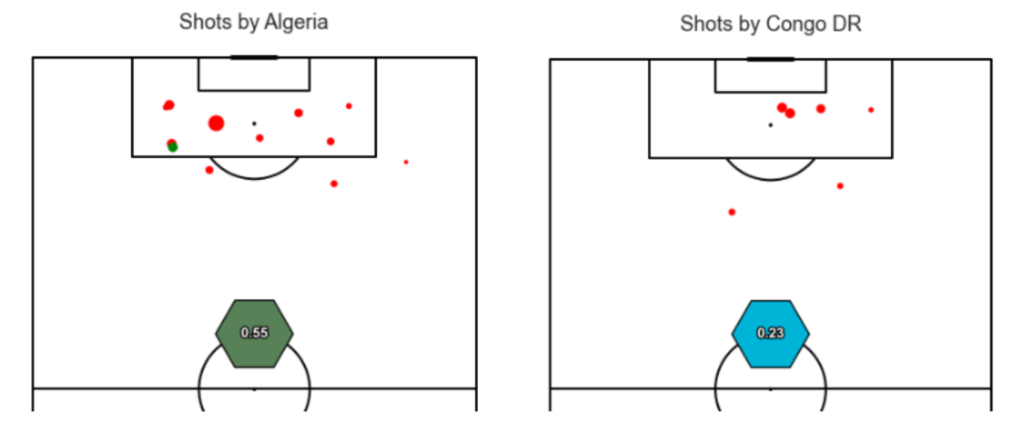
Algeria, one of the more convincing sides during the group stage, struggled to impose attacking fluency against a strong Congolese back four of Kayembe, Mbemba, Tuanzebe, and Wan-Bissaka. Despite that solidity, DR Congo posed little attacking threat themselves. Their most dangerous attacker, Théo Bongonda, was kept quiet by disciplined Algerian defending.
Across 120 minutes, DR Congo managed just six shots, with only two coming after half-time.
Algeria were not prolific either, but they continued to generate sporadic opportunities inside the box. Their persistence was rewarded late in extra time, scoring with their 11th and final shot of the match.
Egypt, meanwhile, continued to serve more of the same: nutritionally sound, but largely flavourless football. Once again, however, the Pharaohs emerged victorious.
Benin produced a brave performance, particularly toward the end of normal time, but Egypt found composure again in extra time. A well-timed header followed by a clinical Mo Salah counter-attacking finish secured their place in the quarter-finals.
The Big Hitters
Nigeria continued their near-flawless AFCON campaign with a comfortable victory over Mozambique. The Super Eagles dominated from the opening stages and broke the deadlock early.
The underlying numbers were particularly impressive: a PPDA of 6.6, 22 box passes (40% success), and a total xG of 2.75. Individually, Ademola Lookman once again stood out, posting by far the highest OBV. Akor Adams looked almost equally dangerous, while Victor Osimhen continued his reliable scoring run.
Côte d’Ivoire were the other major statement-makers. Led by the youthful and exciting duo of Amad Diallo and Yan Diomandé, both posting OBV figures above 0.75. The Elephants impressed both statistically and tactically.
Interestingly, Côte d’Ivoire tilted their attacking focus more heavily to the left than in previous matches, highlighting Diomandé’s growing influence. Just as importantly, they managed the game intelligently: dominating the first half, capitalising early, and controlling the second period to see the match out with maturity.
Looking ahead…
The quarter-final line-up appears predictable on paper, yet still promises more unpredictability on the pitch. What is becoming increasingly apparent, however, is a widening gap between the continent’s top six to eight nations and the rest.
As the tournament moves into its decisive phase, the margins will narrow further. The teams that progress are unlikely to be those with the clearest identity alone, but those capable of knowing when to preserve it, and when to let it go.
 Antoine Maratray
Leave a comment